Curriculum Intent
Our curriculum aims to foster creativity, innovation, practical skills and critical thinking, preparing students to thrive in the workplace and society. We develop pupils to harness their employability skills by recognising the talents and recognising how transferable they can be into different industry sectors. Artistic and design skills most commonly used in the creative industries which stretch from web design to commercial product design can also be used in aspects of business procurement and operational delivery.
We harbour the Values and Culture of Respect, Hard Work, Positivity, Community, Diversity, Ambition: These core values are embedded in our curriculum, ensuring students develop into well-rounded individuals.
We encourage students to take risks and learn from their experiences, promoting resilience and problem-solving skills. This is achieved through projects which develop practical skills such as developing work and knowledge of electronics to create mood lamp. Or by studying contact assessing the disciplines of portraiture and observation drawing.
Aims and Objectives
‘Art and design is not just a subject to learn, but an activity that you can practice: with your hands, your eyes, your whole personality’ Quentin Blake, Children’s Laureate
Art and Design is to embody some of the highest forms of human creativity. A high-quality art and design education should engage, inspire and challenge students, equipping them with the knowledge and skills to experiment, invent and create their own works of art, craft and design.
‘Art develops spiritual values and contributes a wider understanding to the experience of life, which helps to build a balanced personality’. Bridger Riley, Painter
We aim to develop the ability to think critically and develop a more rigorous understanding of art and design. Pupils should also know how art and design both reflect and shape our history, and contribute to the culture, creativity and wealth of our nation.
- Develop creativity and imagination
- Enhance technical skills in drawing, painting, sculpture and other art and appreciation of various art forms
- Foster critical thinking and analytical skills
- Continuous assessment through projects and portfolios
- Formal assessments through home learning
Cultural Capital and Extra-Curricular Activities
We aim to emphasize the importance of cultural capital by providing a wide range of experiences with a view to enriching the individual and making their education more relevant and relatable in an ever-changing world. We do this through educational trips with bespoke sessions at further education providers such as John Leggott College, we host guest speakers and practitioner demonstrators. We offer clubs and extra-curricular activities to support the development of new talents and interests. By providing pupils with this programme of opportunity we hope they will be able to make valued judgments in their career and contribute extensively to society. Using their enhanced knowledge of cultural capital pupils will be able to increase their opportunity in exam and academic success.
Finally, we take immense pride in ensuing all students can access our Art and Design Technology curriculum and achieve in these subjects regardless of any previous barriers to education they may have faced in the past. We have a fantastic record ensuring all can thrive and achieve.
Impact
The curriculum sets out what is being taught to enable pupils to have a deepened understanding of the required knowledge and application of skills.
Planned and scheduled half-termly assessments for each year group across the breadth of the curriculum with a particular focus linked to the appropriate curriculum content:
- Pupils are taught in smaller mixed ability groups
- Half termly data collections to monitor pupil progress and identify the required subsequent actions
- Pupil Voice activities
- Pupil engagement in Extended Learning tasks
- Monitoring of Teaching and Learning within lessons
- Work scrutiny activities
- Line Management Meetings
- Departmental Meetings
These qualitative assurance methods are not definitive and others will be included. However, they are essential in evaluating the impact of the curriculum.
Implementation
The Art curriculum is taught alongside Design and Technology on a project rotation. This enables students to receive 1 lesson of Art per week over the course of the year.
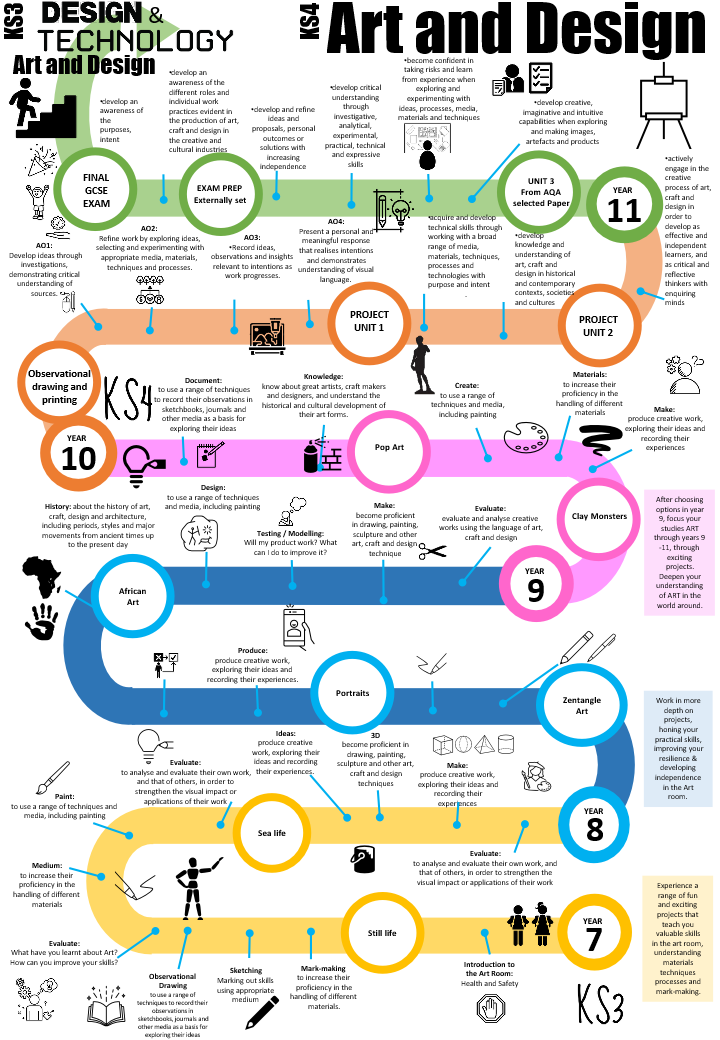
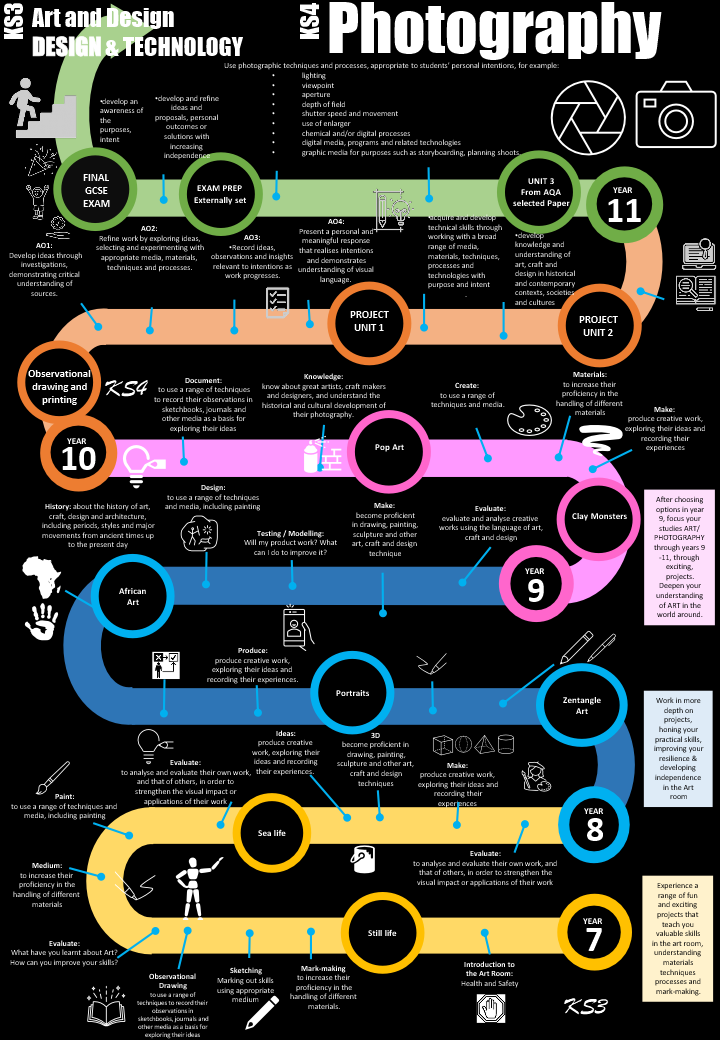
The programme of study is designed to map a curriculum pathway to GCSE courses (Art and Design Fine Art, Photography and Art 3D Architecture. These are known as curriculum road maps.
Key Stage 3
The curriculum in Key Stage 3 (Years 7,8 & 9) is broad and balanced across Art ensuring all pupils are provided with exposure to the knowledge and skills required to enable progress.
- Pupils will use a range of techniques to record their observations in sketchbooks, journals and other media as a basis for exploring their ideas
- They will use a range of techniques and media, including painting and printmaking
- Pupils have the opportunity to increase their proficiency in the handling of different materials
- Analyse and evaluate their own work and that of others, in order to strengthen the visual impact or applications of their work
- Learn about the history of art, craft, design and architecture including periods, styles and major movements across time to the present day
Key Stage 4
The Key Stage 4 curriculum is studied in Years 10 & 11 (a 2 year curriculum). Students can make the step up to Art and Design Based courses at GCSE level.
Art and Design
Our programme is designed to unlock pupils creative and imaginative potential. We aim to enhance enjoyment in developing understanding of the visual world, learning practical skills and responding to ideas and issues in ways that are personal to our pupils.
Art and Design is about looking, learning, thinking and communicating ideas. It inspires creative thinkers.
Pupils have the opportunity to take part in drawing, painting, mixed media, sculpture, ceramics, printmaking, photography and graphic design as well as having the opportunity to do their own briefs which are personal to their own interests.
There are four skill areas (assessment objectives – AO’s) you will be judged against:
- Your research and observations into existing work (AO1)
- Your ability to explore and experiment with materials and ideas (AO2)
- Your skills in recording and observations (AO3)
- Your ability to create an original as an outcome (AO4)
The projects we will cover include:
Natural forms – which explores the natural forms and inspiration in harmony with nature for effective creative works.
Portraits – which will explore how effective portraits tell identity and form.
Externally set project in year 11 – the themes for this will be set by the exam board.
Art and Design 3D Architecture
Our programme is designed to unlock pupils creative and imaginative potential. We aim to enhance enjoyment in developing understanding of the visual world, learning practical skills, and responding to ideas and issues in ways that are personal to our pupils.
Art and Design is about looking, learning, thinking and communicating ideas. It inspires creative thinkers.
Pupils have the opportunity to take part in drawing, painting, mixed media, sculpture, ceramics, printmaking, photography and graphic design as well as having the opportunity to do their own briefs which are personal to their own interest.
There are four skill areas (assessment objectives – AO’s) you will be judged against:
- Your research and observations into existing work (AO1)
- Your ability to explore and experiment with materials and ideas (AO2)
- Your skills in recording and making (AO3)
- Your ability to create something original as an outcome (AO4)
The projects we will cover include:
Abstraction – which explores the purpose of effective architecture and design, how it impacts upon society and creating effective creative building solutions which are bold and routed in Bauhaus design.
Eco Building Project – which will explore how effective design should work with natural forms as inspiration in harmony with nature and be sustainable for the future.
Externally set project in year 11 – the themes for this will be set by the exam board.
Photography
Our programme will feed pupils creative and imaginative minds. They will enjoy developing understanding of the visual world, learning practical skills and responding to ideas and issues in ways that are personal to them.
Photography is about looking, learning, thinking and communicating ideas. It inspires creative thinkers. Photography means ‘drawing with light’ and it is this philosophy we aim to capture, exploring various techniques to create images along the way and pupils capture the world as they see it.
There are four skill areas (assessment objectives – AO’s) you will be judged against:
- Your research and observations into existing work (AO1)
- Your ability to explore and experiment with materials and ideas (AO2)
- Your skills in recording and observations (AO3)
- Your ability to create an original as an outcome (AO4)
The projects we will cover include:
Natural forms – which explores the natural forms and inspiration in harmony with nature for effective creative works.
Portraits – which will explore how effective portraits tell identity and form.
Externally set project in year 11 – the themes for this will be set by the exam board.
Home Learning
Homework is an essential element of creative study. Independence and resilience are vital to the process of marking Art. It also enables pupils to further enhance their understanding of the subject. Tasks will vary depending on the subject and Key Stage, but may include reading, writing, research, revision, sketching, photography, modelling and related project work.
Publications
In the department we are committed to lifelong learning and as staff following the principles of the following publications.
Books
Edwards B, 1999. The New Drawing on the Right Side of the Brain, Tarcher
Sherrington T, 2020. Rosenshine’s Principles in Action. John Catt Educational
Journal Publications
AD magazine, The International Journal of Art & Design Education (iJADE)
Budge K, 2016. Teaching Art & Design: Communicating creative practice through embodied and tacit knowledge. Arts and Humanities in Higher Education, 15 (3-4)
Sawyer R K, 2017. Teaching creativity in Art and Design studio classes: A systematic literature review. Educational research review, 22
Blogs and Social Media
Twitter@leedsartteacher
Twitter@nsead_sophie
Professional affiliations
The Arts Council