Curriculum Intent
Our curriculum aims to foster creativity, innovation, practical skills and critical thinking, preparing students to thrive in the workplace and society. We develop pupils to harness their employability skills by recognising the talents and recognising how transferable they can be into different industry sectors. Artistic and design skills most commonly used in the creative industries which stretch from web design to commercial product design can also be used in aspects of business procurement and operational delivery.
We harbour the Values and Culture of Respect, Hard Work, Positivity, Community, Diversity, Ambition: These core values are embedded in our curriculum, ensuring students develop into well-rounded individuals.
We encourage students to take risks and learn from their experiences, promoting resilience and problem-solving skills. This is achieved through projects which develop practical skills such as developing work and knowledge of electronics to create mood lamp. Or by studying contact assessing the disciplines of portraiture and observation drawing.
Aims and Objectives
Design and Technology is an inspiring, rigorous and practical subject. Using creativity and imagination, students design and make products that solve real and relevant problems, considering their own and others’ needs, wants and values. Students learn how to take risk, becoming resourceful, innovative, enterprising and capable citizens. Instilling a love of cooking a student will also open a door to one of the great expressions of human creativity.
- Encourage innovation and practical problem-solving
- Enhance technical skills and the use of tools, materials and technology
- Promote understanding of the design process from concept to creation
- Learning how to cook is a crucial life skill that enables pupils to feed themselves and others affordably and well, now and in later life
Design and technology is about making things that people want and that work well. Creating these things is hugely exciting: it is and inventive, fun activity. James Dyson, Chairman, Dyson Ltd
Our Curriculum in Key Stage 4
In year 10 students embark on their GCSE and Vocational studies which provide the stepping stone for further education and unlocking future careers. Students choose from Art and Design, Photography and Hospitality and Catering. These courses have been selected as they provide the broadest range and opportunity to progress at local colleges and are in industries which are currently recruiting.
Assessment and Evaluation
Design Technology and Hospitality and Catering:
- Assessment of practical projects
- Written exams and coursework
Cultural Capital and Extra-Curricular Activities
We aim to emphasize the importance of cultural capital by providing a wide range of experiences with a view to enriching the individual and making their education more relevant and relatable in an ever-changing world. We do this through educational trips with bespoke sessions at further education providers such as John Leggott College, we host guest speakers and practitioner demonstrators. We offer clubs and extra-curricular activities to support the development of new talents and interests. By providing pupils with this programme of opportunity we hope they will be able to make value judgments in their career and contribute extensively to society. Using their enhanced knowledge of cultural capital pupils will be able to increase their opportunity in exam and academic success.
Finally, we take immense pride in ensuring all students can access our Art and Design Technology curriculum and achieve in these subjects regardless of any previous barriers to education they may have faced in the past. We have a fantastic record ensuring all can thrive and achieve.
Implementation
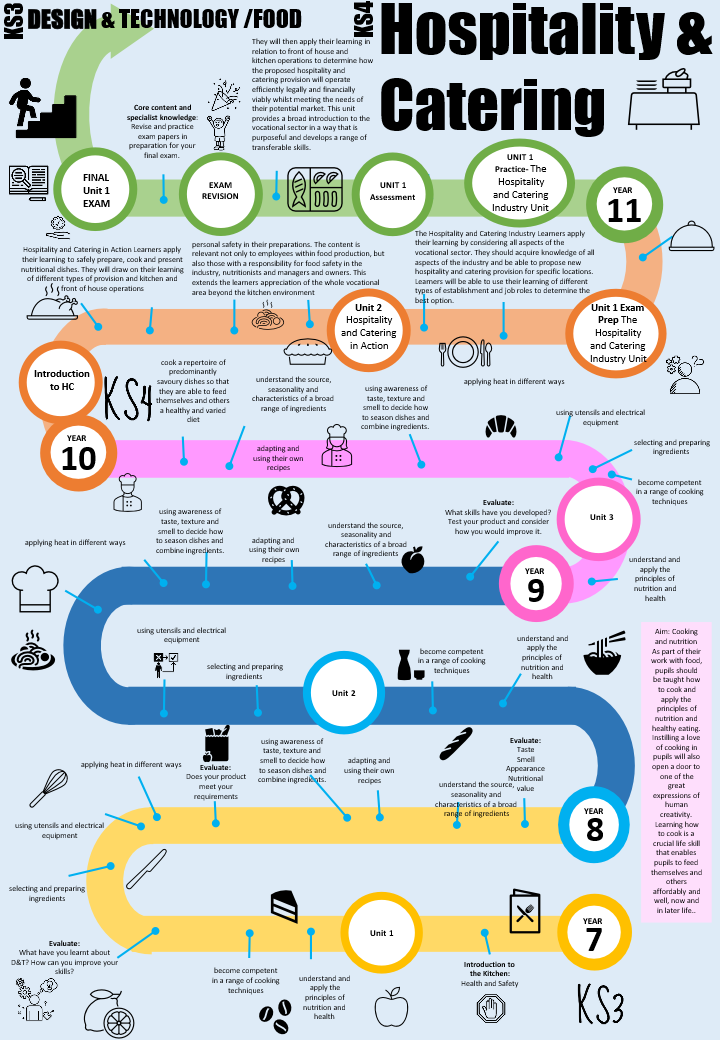
The Design and Technology curriculum is taught in a rotation. This enables students to receive resistant materials and food and nutrition through design technology over the course of the year.
The programme of study is designed to map a curriculum pathway to a level 2 course Hospitality and Catering. This is known as a curriculum road map. This also includes skills for 3D architecture (Art 3D).
Impact
The curriculum sets out what is being taught to enable pupils to have a deepened understanding of the required knowledge and application of skills.
Planned and scheduled half-termly assessments for each year group across the breadth of the curriculum with a particular focus linked to the appropriate curriculum content:
• Pupils are taught in smaller mixed ability group
• Half termly data collections to monitor pupil progress and identify the required subsequent actions
• Pupil Voice activities
• Pupil engagement in Extended Learning tasks
• Monitoring of Teaching and Learning within lessons
• Work scrutiny activities
• Line Management Meetings
• Departmental Meetings
These qualitative assurance methods are not definitive and others will be included. However, they are essential in evaluating the impact of the curriculum.
Key Stage 3
The curriculum in Key Stage 3 (Years 7, 8 & 9) is broad and balanced across Design and Technology ensuring all pupils are provided with exposure to the knowledge and skills required to enable progress.
- Develop the creative, technical and practical expertise needed to perform everyday tasks confidently and to participate successfully in an increasingly technological world
- Build and apply a repertoire of knowledge, understanding and skills in order to design and make high-quality prototypes and products for a wide range of users
- Critique, evaluate and test their ideas and products and the work of others
- Understand and apply the principles of nutrition and learn how to cook
Key Stage 4
The Key Stage 4 curriculum is studied in Years 10 & 11 (a 2 year curriculum)
Hospitality and Catering
Our programme will provide pupils with knowledge of the hospitality and catering sector including all businesses that provide food, beverages and/or accommodation services. This is in response to the British Hospitality Association who state that hospitality and catering, is Britain’s fourth largest industry and accounts for around 10% of the total workforce. Since 2010, over 25% of all new jobs have been within the hospitality and catering sector with the majority of new roles falling within the 18-24 age group, according to a report by People 1P st P.
The projects we will cover include:
Unit 1 – Understanding the importance of nutrition. How cooking methods can impact on nutritional value 2.2.1 Factors affecting menu planning 2.2.2 How to plan production 2.3.1 How to prepare and make dishes 2.3.2 Presentation techniques 2.3.3 Food safety practices 2.4.1 Reviewing of dishes 2.4.2 Reviewing own performance.
Unit 2 – Practical: Building preparation and cooking skills and learn through practice.
Externally set Unit 2 Brief usually in Year 11.
Unit 3 – Exam Externally set.
Home Learning
Homework is an essential element of creative study. Independence and resilience are vital to the process of designing marking products. t also enables everyone to further enhance their understanding of the subject. Tasks will vary depending on the subject and Key Stage, but may include reading, writing, research, revision and sketching, photography, CAD CAM, computing, cookery preparation and related project work.
Publications
In the department we are committed to lifelong learning and as staff following the principles of the following publications.
Books
Luckin R S Puntambekar, Goodyear, R Grabowski, B L Winters, N Underwood, J., 2013. Handbook of Design in Educational Technology Copyright Year 2013.
Sherrington T, 2020. Rosenshine’s Principles in Action. John Catt Educational.
Journal Publications
AD magazine, The International Journal of Art & Design Education (iJADE).
Mawson B, 2003. Beyond the Design Process: An alternative pedagogy for technology education. International Journal of Technology and Design Education, 13(2), pp. 117-128.
Middleton H, 2005. Creative thinking, values and design and technology education. International Journal of Technology and Design Education, 15(1), pp. 61-71.
Lewis T, 2005. Creativity A Framework for the Design/Problem Solving Discourse in Technology Education. Journal of Technology Education, 17(1), pp. 35-52.